Estimation of the Parent Layer of the Collapse Layer
In the shell midden on the northern slope of the Ariyoshi Kita Shell Mound, the collapse layer is deposited in almost all areas below the cliff formed by gully erosion. The location of the parent layer of this collapse layer was estimated using Section 30 (exfoliation section) as an example.
Creation of a 3D distribution model of pottery in a test grid, Part 1: Collapsed layer
A 3D distribution model of pottery and earthenware products related to the collapsed layer of 331 grids of the shell layer on the northern slope of the Ariyoshi Kita Shell Mound was created. Many pottery fragments excavated from the base layer of the gully erosion topography can be observed. The formation of the erosion topography is synchronized with the dumping of pottery and shells.
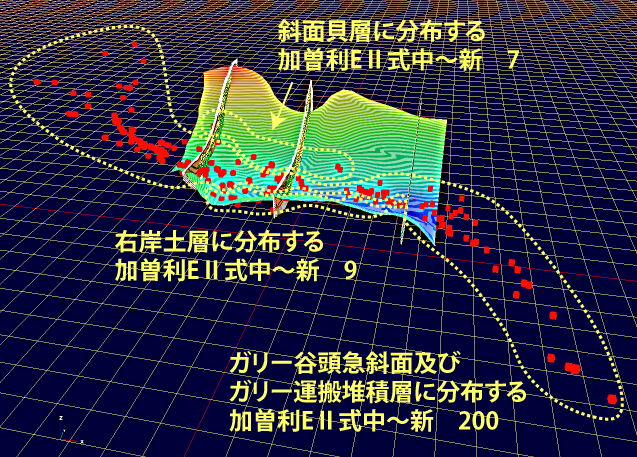
3D model of the relationship between the estimated interface between the collapsed layer and the sloping shell layer and the Kasori EII new stage pottery
The Kasori EII type new stage is the final stage of pottery dumping in the shell layer on the northern slope of the Ariyoshi Kita Shell Mound. It also reduces the number of discards.
A 3D model of the relationship between the estimated interface between the collapsed layer and the sloping shell layer and Kasori EII medium-to-new stage pottery
From the mid-stage of Kasori EII type, the situation of rapid increase in pottery dumping will continue. As in the middle stage of the Kasori EII type, the pottery was dumped on the steep slope of the gully valley at this stage, and most of it was deposited in the gully transport sediment layer.
3D model of the relationship between the estimated interface between the collapsed layer and the sloping shell layer and the Kasori EII middle stage pottery
In the Ariyoshi Kita Shell Mound North Slope Shell Layer, the amount of pottery discarded increases sharply in the middle stage of the Kasori EII type. Most of them are distributed continuously from the gully valley steep slope to the gully transport sedimentary layer. The distribution principle of the shell layer and the pottery is different.
3D model of the relationship between the estimated interface between the collapsed layer and the sloping shell layer and the Kasori EII type old stage pottery
Kasori EII style old-stage pottery has been unearthed little since EI. The same pottery fragments were unearthed from the steep valley slope and the downstream sedimentary layer 28m away.
3D model of the relationship between the estimated interface between the collapsed layer and the sloped shell layer and the Nakabyo pottery
Compared to the pottery of the early period and the Atamadai type, the Nakabyo type pottery is characterized by the fact that some of it was unearthed from the collapsed layer. Combined with those excavated from the slope shell layer, it accounts for 36% of the total. The Nakabyo type pottery seems to be the key in considering the relationship between the collapsed layer and the sloped shell layer.
Relation between Collapsed Layer, Slope Shell Layer, Gully Transported Sedimentary Layer and Atamadai-type Pottery
Most of the Atamadai-type pottery was excavated from the gully valley top and the gully transport sedimentary layer, but some were also excavated from the slope shell layer. One item was excavated from the bottom of the sedimentary layer, and I hypothesized that it was discarded during the Atamadai period.
Relationship between collapsed layer, sloped shell layer, gully-transported sedimentary layer and initial pottery and early pottery
I divided the shell layers of the north slope shell layer of the Ariyoshi Kita Shell Mound into three layers: the collapsed layer, the slope shell layer, and the gully transport sediment layer, and began to observe the relationship between these layers and the type of pottery. Most of the early pottery was excavated from the gully-transported sedimentary layer. And some are excavated from the bottom of the sedimentary layer. Based on this fact, I hypothesized that early pottery might have been discarded in the early Jomon period.
North Slope Shell Layer of Ariyoshi Kita Shell Mound
Estimated interface 3D model of collapsed layer and sloping shell layer
I created a 3D model of the presumed interface between the collapsed layer and the sloped shell layer of the Ariyoshi Kita Shell Mound North Slope Shell Layer. Looking at the correspondence with the 3D distribution of pottery, there are a few pottery excavated from the collapsed layer, and it seems to be one of the leading materials for examining the formation period of the collapsed layer.


e.png)
e.png)

e.png)


e%20%E3%81%AE%E3%82%B3%E3%83%94%E3%83%BC.png)
e%20%E3%81%AE%E3%82%B3%E3%83%94%E3%83%BC.png)


e.png)
e-%E3%81%AE%E3%82%B3%E3%83%94%E3%83%BCe.png)


e.png)
e.png)
e-%E3%81%AE%E3%82%B3%E3%83%94%E3%83%BCe.png)


e.png)
e.png)
e.png)